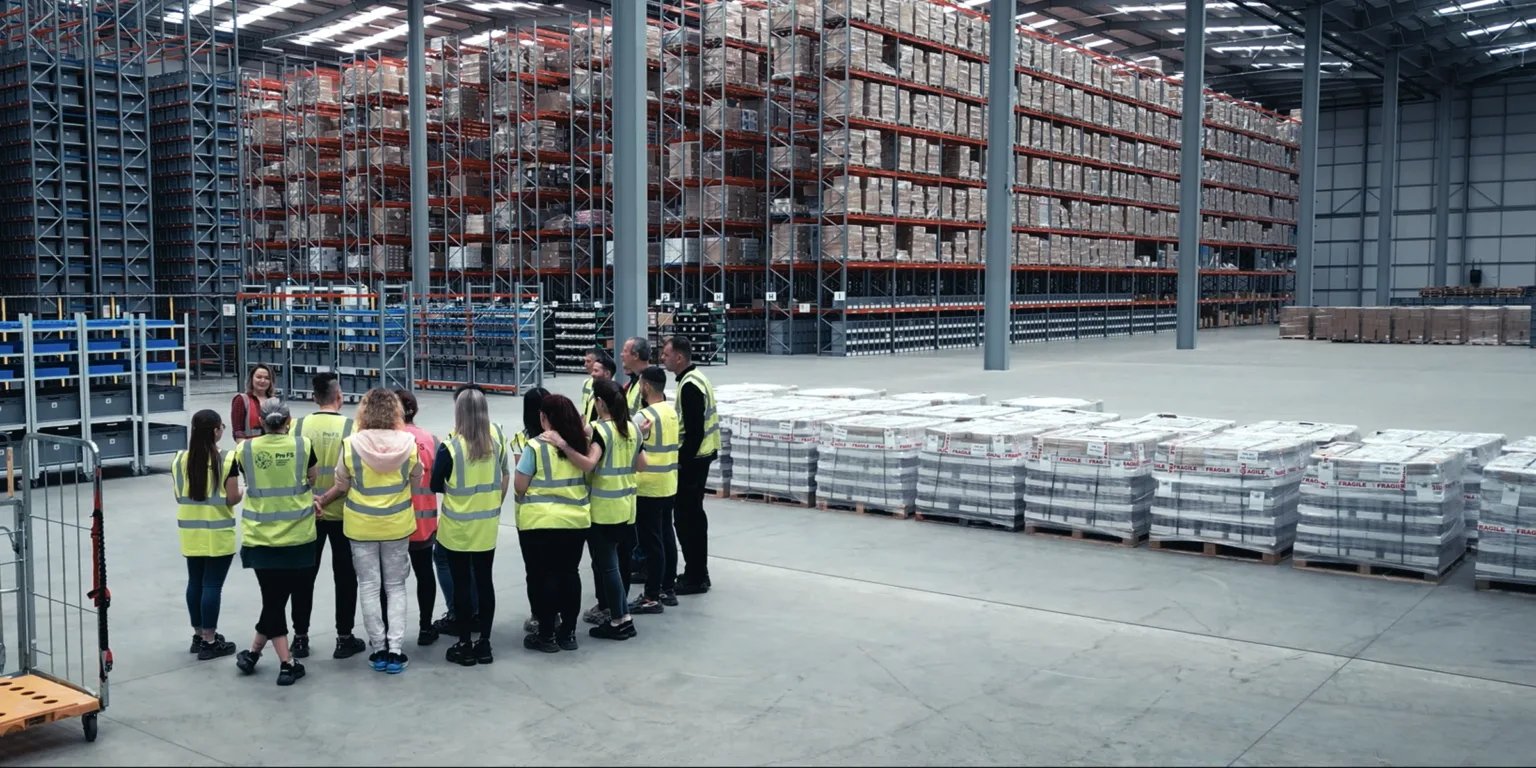
You’ve shortlisted your 3PL providers, reviewed the proposals, and compared the numbers. Now comes the part that actually matters.
The warehouse tour.
Most procurement teams treat the site visit as a formality. A tick in the box before the contract conversation begins. That’s a costly mistake. According to the NTT DATA 2025 Third-Party Logistics Study, 89% of shipper-3PL relationships are reported as successful. But only 68% of shippers believe their 3PL provides genuinely innovative approaches to logistics improvement. The gap between those two figures lives on the warehouse floor. And the tour is where you can really get under the skin of how this works.
This playbook gives you a structured framework for evaluating any fulfilment facility. It covers what to watch for, what to ask, and the green flags and red flags that help you walk away with genuine confidence in your decision.
Before You Arrive: Set the Visit Up for Both Sides
The most productive 3PL warehouse tours happen when both sides treat the visit as a genuine operational introduction. Request to walk with an operations manager or warehouse supervisor alongside the account team, and ask to visit during a standard working window rather than a set-piece showcase. Providers who welcome this approach are confident in what their facility delivers day to day. That confidence, demonstrated before the contract conversation begins, is one of the clearest signals of a strong operational partner.
Observation Zone 1: Layout, Organisation, and Facility Condition
The physical layout of a warehouse tells you a great deal before a single question is asked.
A facility with clear aisle markings, labelled storage bays, defined inbound and outbound zones, and an active receiving dock is showing you operational discipline in its most visible form. Pick faces stocked, stock in designated locations, workflow moving without visible bottlenecks. These are the details that separate a facility built for precision from one built for appearances. Research shows that warehouses optimised for layout achieve up to 25% faster order fulfilment, and that RFID and barcoding adoption reduces inventory errors by 40%.
Compliance standards are another observable indicator of operational culture. A 2024 GAO report on warehouse workplace safety found that OSHA cited warehouse and last-mile delivery employers for more than 2,500 violations across a five-year period, with fall protection, hazard communication, and powered equipment operation among the most persistent categories. In modern automated facilities, the compliance lens shifts accordingly. Robotics operating zones, pedestrian demarcation, emergency stop accessibility, and equipment charging infrastructure all carry the same weight that powered truck safety did in traditional warehousing. A facility that manages autonomous systems with clear zoning, proper signage, and documented safety protocols is showing you an operational discipline that extends well beyond the warehouse floor.
- A disciplined facility demonstrates this in practice:
- Autonomous robot operating zones are clearly demarcated and respected
- Bays are labelled with bin locations that match the WMS
- A dedicated returns processing area is visible, separate from outbound stock
- Receiving docks show active workflow rather than idle staging
Observation Zone 2: The WMS Demo
The WMS demo is often the most revealing part of your 3PL warehouse visit checklist. Ask to see a live demonstration of the warehouse management system. The actual system, running live data. A slide deck or screen recording tells you little about daily operational reality.
There are three things you are verifying here.
Real-Time Inventory Visibility
Control tower visibility is now the top technology requirement for shippers, cited by 68% in current industry data. Ask the operations contact to show you a live SKU count for a client whose inventory is on the floor. Real-time visibility means the figure in the system matches what you can see in a bay, instantly, without running a report.
System Recency
Industry benchmarks show that 70% of 3PLs have upgraded their WMS within the past five years. Ask directly when the current system was last upgraded and what version they are running. A provider who hesitates or deflects on this question is likely running outdated infrastructure. Ask also whether the WMS supports API integration with the platforms your business uses, specifically Shopify, WooCommerce, or your ERP.
Mobile and Scan-to-Pick Capability
Mobile WMS adoption delivers up to 25% improvement in receiving accuracy and a 30% reduction in physical inventory count time, according to peer-reviewed research in B2B logistics networks. If the warehouse is running paper-based pick tickets or manual clipboard counts, you are looking at a facility leaving measurable efficiency and accuracy gains on the table.
Observation Zone 3: The Live Pick-and-Pack Run
Order picking accounts for 55 to 65% of total warehouse operating expenses. It is the single most financially significant process you will observe. Ask to watch a live pick run for several minutes. Insist on a real order rather than a demonstration pick. Watch what actually happens on the floor.
You are looking for four things: the picker’s use of technology, scan verification at the pack station, the time from pick to pack completion, and how exceptions are handled. An experienced picker using voice-directed or scan-to-pick technology with consistent confirmation beeps is a strong green flag. A picker navigating by memory and skipping scan verification warrants a direct follow-up conversation.
Ask the supervisor what the current pick accuracy rate is and how it is tracked. Any answer below 99% warrants a follow-up question about what they are doing to address it.
Green Flag vs. Red Flag Reference Guide
| Green Flag | Red Flag |
| WMS upgraded within the last five years | Paper-based pick tickets still in use |
| Live inventory accuracy above 97% | Vague or delayed response when asked for live accuracy data |
| Dedicated returns processing area with barcode scanning | Returns stacked in general receiving without triage |
| Staff who can articulate the WMS without prompting | Tour led entirely by a sales contact, no operations staff present |
| Real-time inventory visibility visible in the system demo | Visibility described as a future roadmap item with no confirmed date |
Observation Zone 4: Inventory Accuracy
Ask the question directly: what is your current inventory accuracy rate? Then ask how it is measured and how frequently cycle counts are run. Research published in the International Journal of Science and Research Analysis places the industry average inventory accuracy between 65% and 75%, with 97% representing a reliable operational threshold. A provider below 97% should be able to explain what is driving the gap and what corrective action is underway.
Inventory Record Inaccuracy affects over 65% of SKUs in commercial warehousing and can spread systemically through supply chains. A structured, documented cycle count schedule is a baseline expectation. Ask to see it during the tour.
Peer-reviewed analysis of warehouse management performance has found a correlation coefficient of 0.993 between inventory accuracy and overall operational efficiency. That figure means inventory accuracy stands as the single strongest predictor of whether a facility runs well, outranking every other operational variable measured.
Observation Zone 5: Workforce and Staff Stability
Workforce stability is worth exploring directly during the tour. Ask the operations manager about floor-level retention and training investment. Staff who move around the facility with purpose and familiarity, and who can speak to their role and process with confidence, are a reliable indicator of a well-managed operation.
Labour shortages have affected the supply chain significantly. In 2022, 56% of 3PLs reported operational impact from staff shortages, with high turnover correlating directly with pick errors, receiving mistakes, and SLA failures. Ask the operations manager what their floor-level staff retention rate looks like and what training investment they make in new starters.
A provider with clear answers on retention and training investment is demonstrating the workforce discipline that directly supports pick accuracy and SLA performance. In modern fulfilment, the best operations run automation and people in tandem. The technology handles repetition and scale; the team handles judgement, exceptions, and the moments that matter to your customers.
Key Questions for Your 3PL Site Visit
A thorough facility assessment combines what you observe with what you ask. The following questions are worth raising during any structured 3PL site visit, and the quality of the answers will tell you as much as the answers themselves:
- What is your current inventory accuracy rate, and how is it measured?
- When was your WMS last upgraded, and does it support real-time API integration?
- What is your pick accuracy rate, and what is your escalation process for exceptions?
- Can you show me your returns processing area and explain the triage workflow?
- What is your same-day and next-day cut-off time, and can we verify that with a live order?
- What does your cycle count schedule look like, and can you show me the record?
- What percentage of your floor staff have been here for more than twelve months?
- What is your AI or technology roadmap for the next eighteen months?
That last question is worth holding. In current industry data, 74% of 3PLs with AI capability are at risk of losing clients if they deprioritise that investment. A provider who responds with a clear roadmap is signalling strategic awareness. One who dismisses the question is showing you their ceiling.
Returns Processing: A Critical Checkpoint
E-commerce return rates reached approximately 17% of total US retail sales in 2024, with apparel exceeding 30%, according to data from Mitsui & Co. Global Strategic Studies Institute. Returns processing has become a core operational function, carrying the same strategic weight as inbound receiving or outbound despatch.
On your tour, locate the returns area. Is it dedicated or does it share space with inbound receiving? Are returned items barcode-scanned on arrival, or physically sorted by eye? Is there a visible triage process that separates resaleable, refurbishable, and write-off stock?
A provider that handles returns in a structured, technology-supported workflow is one that understands modern e-commerce economics. Providers relying on manual sort and clipboard tallies are creating a cash flow drag that will eventually show up in your reconciliation reports.
SLA Compliance: Verify on the Floor
SLA claims in proposals are self-reported. On the tour, verify them. Ask the operations manager to walk you through what happens to an order placed at 2pm. Where does it go? Who picks it? When does it leave the building?
Current data shows that 48% of shippers and 53% of 3PLs report customers now expect delivery in under two days. That pressure sits on your fulfilment provider’s floor. Ask them to describe the order journey in operational detail, without reference to marketing materials, and then watch a live order move through the system.
A provider who can show you the process end to end, with confidence and without hesitation, is one that runs it reliably every day.
The Tour Completes the Picture
A proposal sets the context. The warehouse tour is where that context becomes tangible. Seeing an operation in action, asking the right questions, and observing the daily rhythm of a facility gives procurement teams something a document never can: direct evidence.
This framework covers the variables that matter most when finalising a fulfilment partner. Inventory accuracy. Technology infrastructure. Workforce stability. Returns capability. SLA performance. Each one is observable on the floor, and each one has a measurable impact on your business after go-live.
Procurement teams that combine structured on-site assessment with thorough proposal review consistently arrive at partnerships with stronger foundations. The facility visit is not a final test. It is the clearest opportunity to understand exactly what your fulfilment operation will look like in practice.
Planning a facility visit?Pro FS welcomes visits. Our operations team walks every prospective partner through the floor, live systems, and performance data. To schedule a strategic facility review, contact our team here.